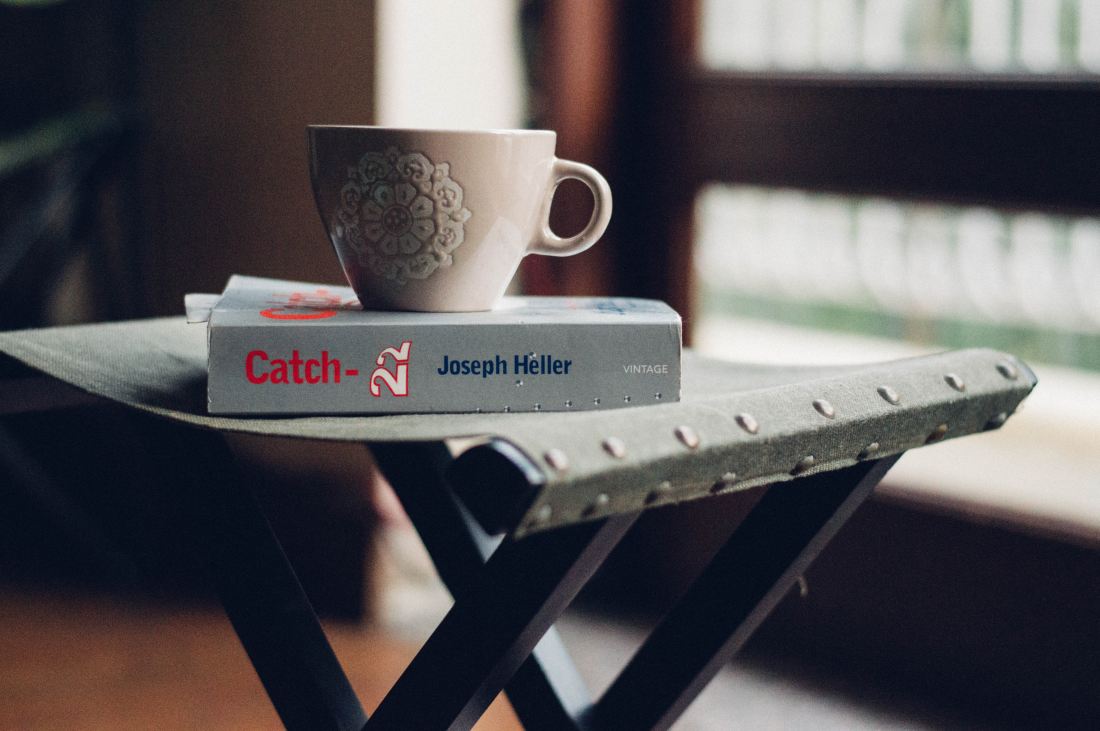
For those unfamiliar with what it means to be in a “Catch-22,” a Catch-22 is a paradoxical situation from which an individual cannot escape because of contradictory rules or limitations. The term originates from the novel Catch-22 by Joseph Heller in 1961.
My rheumatologist is one of the few doctors I have who has an excellent bedside manner — she looks at me when she’s talking to me, acknowledges my concerns, and works with me to pick the best treatment option. She is one of the few doctors who smiles. Her happiness and her demeanor give me hope for my future.
She knows pretty much my entire story from the beginning: my frustration, my struggles, and mainly, my desire to overcome this monster surging within my body. She began referring to my available choices as Catch 22’s, which has resonated with how I’ve been feeling. My options include (A) immediate efficacy but long-term damage or (B) stronger medications that hopefully work long-term but have terrible side effects, including death.
I consider the immediacy of option A. If I have one good week, it could be the week I get my life back on track. I picture myself with a superhuman ability to finish all my tasks quickly and efficiently. The problem is that life never works the way you picture it. I severely miscalculate the effects of option A. Option A aims to return me to my “original self,” not a greater self than I have ever been. I overestimated because just the thought of being able to complete any tasks with minimal pain excites me.
I can never tell when my body will decide to (lack of a better phrase) crap out on me.
I need flexibility, but I also need to earn enough money to support myself. I have three jobs and a few “side hustles.” Still, I feel like I’m never good enough at my work. I always feel like what I put in is never enough. It’s a daily juggling between my work, health, cleaning, and getting enough quality rest.
I must work to afford good healthcare, organic food, better quality products, and a roof over my head. If I work too long, my health will suffer. But if I don’t work long enough, I won’t get paid, and my health will suffer. I never know if pushing myself will put me out of commission for a few hours or days. Normal people can push themselves because they can replenish their energy and wake up feeling amazing and proud of themselves the next day. If I push myself, I may be unable to get out of bed the next day. Sleep does not always replenish my energy. The hardest aspect of chronic illness is trying to explain this Catch-22. It isn’t easy to picture feeling something you have never experienced.
I can err on caution, but I won’t finish my work. I know I’ll be upset and disappointed with myself. I’ll feel like I’ve let my superiors down. I feel tremendously guilty when I underperform. Sometimes, my superiors say something and other times, I feel empty with a passive-aggressive non-response or one-word reply. I try as hard as possible but know it’s not a “regular” pace. In today’s fast-paced world, almost no one has the patience for slowness. It’s not a positive word, especially in terms of productivity. It’s not a word I want to describe me. I’m trying my hardest and giving my work my all. I know it’s not enough.
It’s an isolating feeling to know your work pace is never fast enough.
I often think about how great it would be if I could be normal. I would have more options for where or what to do for work. I would work full-time without worrying about making health insurance payments, needing to leave work due to illness suddenly, and taking time off work to recover.
I would be able to work without feeling like a charity case.
With a full-time job, I would have a regular schedule that would provide structure and stability. I wouldn’t feel like I’m disappointing people at work. I wouldn’t constantly question myself whether I’m being productive and efficient. I would be a very different person.
I don’t have a full-time job. My body and my energy level cannot sustain working consistently. I never know when I will have a flare, when I will have my head over a toilet, or when I must spend the entire day in bed. I can’t earn money consistently, which worries me. Worrying increases my stress level, which increases my anxiety, which then has a toll on my mental health. If I could make more money, I’d be able to afford a therapist to take care of my mental health. It’s a vicious cycle.
There is no consistency in my life.
Before my illnesses, I loved spontaneity and cringed at the thought of a routine or structure. It’s funny how people change. I find myself craving stability and consistency. I never pictured myself this way when I was younger.
I wish I had a solution for the Catch-22 that people with chronic illnesses are forced to live with. Supposedly, employers cannot discriminate against people with disabilities. But at the same time, employers want individuals capable of performing the work placed before them. An employee performing slower will get paid differently than an employee working faster. In the workplace, productivity measures what type of employee you are and how much you will earn.
People always say you can get help, and resources are available to assist you if you’re disabled. Perhaps there are but I’m not disabled enough to qualify. Nor am I poor enough. Or old enough. I don’t fit neatly into any category. I haven’t found any free help or solutions.
I have been lucky to find employers who offer flexibility for my work. I’m very grateful when I can produce any amount of work.
I wish I could work as fast as I once did. I wish I could be the ideal employee. I wish I didn’t feel an incessant need to apologize for myself or my work output. Inside me is a very type-A individual cringing at my current functional ability. Or rather, inability. I wish I had enough stamina to maintain a full-time job consistently. At the very least, I hope to have the energy to finish work tasks I do have without disappointing my supervisors due to symptoms of illnesses that are out of my control.

 Sip of Ambition