The system we live in is founded upon an individual’s health. An individual’s ability to contribute to society and make a livelihood is crucial to thriving and succeeding in today’s world. Without good health, the rest of the system becomes harder, or nearly impossible, to attain.
After health, education is a huge priority in an individual’s ability to succeed and increase their potential and future work income. Once someone has received an education, they can work and make a living for themselves and/or their families. If all of these can be achieved, the individual will have to balance these and their extracurricular activities outside of work to live a fulfilling life and “succeed” living in today’s system.
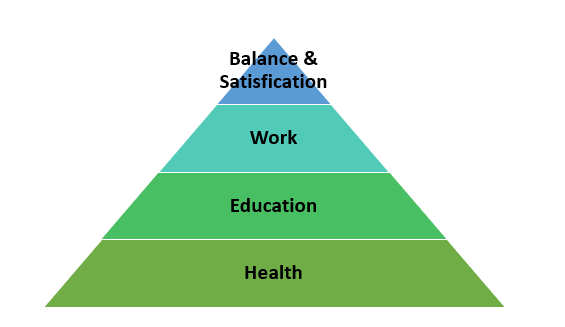
Each step of the system, pictured above as a pyramid, requires the success of the preceding step to function properly. An individual cannot work without good health. An individual can only find balance and satisfaction by working and earning a sufficient income to pay for their necessities (rent, utilities, groceries, transportation, etc.).
The foundation of this system is much more fragile than it appears. Each level of this system must work optimally without overloading. It assumes that most people in our society have good health, to begin with, or that having good health is easy to maintain. This is one of the biggest misconceptions today and the economic climate. Our system also exemplifies how most people, including society, systematically take good health for granted.
The biggest problem with this system is when an individual needs to catch up. For example, when someone’s health begins to fail or suddenly fails without warning.
Some people in the workforce for a while may have savings for emergencies or short-term funds available. Others have families and/or friends they can turn to for support during a closed period. However, the bigger problem occurs when someone younger, without savings, suffers a hit to their health. Or when individuals of any age suffer from chronic conditions. When these conditions first surface, it is not usually easy to determine whether there will be an easy fix (short-term problem) or whether it will be lifelong (chronic problem).
Life becomes harder with chronic conditions. It is even harder when you don’t have support or the resources to improve your condition.
With a chronic condition, it becomes harder for individuals to maintain the level of work they once produced. Employers aren’t supposed to discriminate against individuals with disabilities, but who will hire someone with a high absenteeism rate and a low-quality output rate?
Who will hire someone with an inconsistent schedule based on their fluctuating health condition(s)?
The truth is that full-time work isn’t compatible for individuals with chronic conditions. Full-time work requires eight-hour workdays, five days a week, totaling 40 hours weekly. These days, the desire to make a good impression and demonstrate a strong work ethic requires working over 40 hours weekly.
When an individual suddenly gets a chronic illness, the system crumbles. The system begins to fail. Individuals struggle to make it to work, which adversely affects their health. Eventually, individuals with chronic illnesses must take time off work and seek treatment. While this appears seemingly easy, would you know where to seek medical care if you slowly lost the ability to use your arms and/or legs to the point where you had to leave your job? Would you know where to start? How would you pay for expensive tests and treatments?
You may need a loan unless you have some money in savings. However, savings can only keep you afloat for so long. Without a job, though, you won’t be able to qualify for a loan. Your debt will start to pile up, and you cannot get on emergency credit programs for some relief because instead of earning low income, you now do not earn any income.
You’re now too poor to help.
The more time passes, the more the bills will pile up. Credit card debts will charge late fees, and any loans you may apply for will charge higher interest rates. It becomes harder and harder to keep up with medical bills, credit card bills, and repaying loans and/or school loans.
Unable to find financial assistance, it becomes apparent that corporations, like banks, help low-risk individuals, people with full-time jobs and the ability to pay back the money they borrow.
This isn’t simply a problem occurring amongst a handful of individuals. It is becoming an increasingly prominent generational problem. With the rise of autoimmune diseases and a lower age of onset, the system is crumbling for many young adults. More and more people are entering positions requiring public assistance and cannot work in a competitive work environment. This not only crumbles the system for numerous individuals but also for society. When there aren’t enough people contributing to the nation’s economic growth, the nation will start crumbling.
With the rise of autoimmune diseases, no currently available cures, and the nation’s faulty infrastructure, what will happen to society in a decade? In a few decades? As it is currently functioning, the system will eventually crumble since it is unsustainable.
The system we live in needs to be fixed. It doesn’t work or help people when needed, making it harder for individuals to recuperate and possibly re-enter the workforce. The nation’s healthcare system and work-life must be restructured to prevent a crash.
Solutions may be discovered before the system crumbles. A new approach to how we work, care for ourselves and our families, and the education we receive. They are all interdependent, but the solution lies in only one pyramid step. The answer is yet to be discovered.

 Sip of Ambition