
I’ve contemplated this conundrum to great lengths never truly satisfied with a response. I’m unsure if the following comes from societal standards, wisdom from our elders, or merely common knowledge. Still, it seems to be of utmost importance now, during this pandemic, that you should take care of yourself first before trying to help others. While I do think that fears of the pandemic and the spread of COVID-19 did bolster the emphasis on self-care, I also think that self-care perhaps holds a different generational significance. Particularly for those of us who come from a different country, or perhaps also individuals who were raised with strong, homegrown values, the importance of family togetherness, honor, and respect towards your elders was likely instilled in your mind from childhood. Growing up, we’ve learned to tend to our family and get a stronger sense of where our priorities stand. However, caught up in our increasingly faster, always on-the-go lives, we forgot to leave some room for ourselves.
We forgot to prioritize ourselves.
I struggle to delineate this rather thin, obscure line between what constitutes a selfless or selfish act. While we aren’t necessarily meant to think of the context of selflessness or selfishness within a theory of absolutism, I often find myself doing that. It would be nice, even heartwarming if I could feel this way while I am being selfless; things are not always so black and white, and similarly, I am not always purely selfless or purely selfish. However, I often think of the acts I do for myself as selfish, regardless of the context or conditions surrounding my actions. This can and does sometimes lead to feelings of guilt. Should I be devoting my attention elsewhere? Why can I separate self-care and selfishness while observing the actions of others but not necessarily my own? These questions continued to plague me into adulthood.
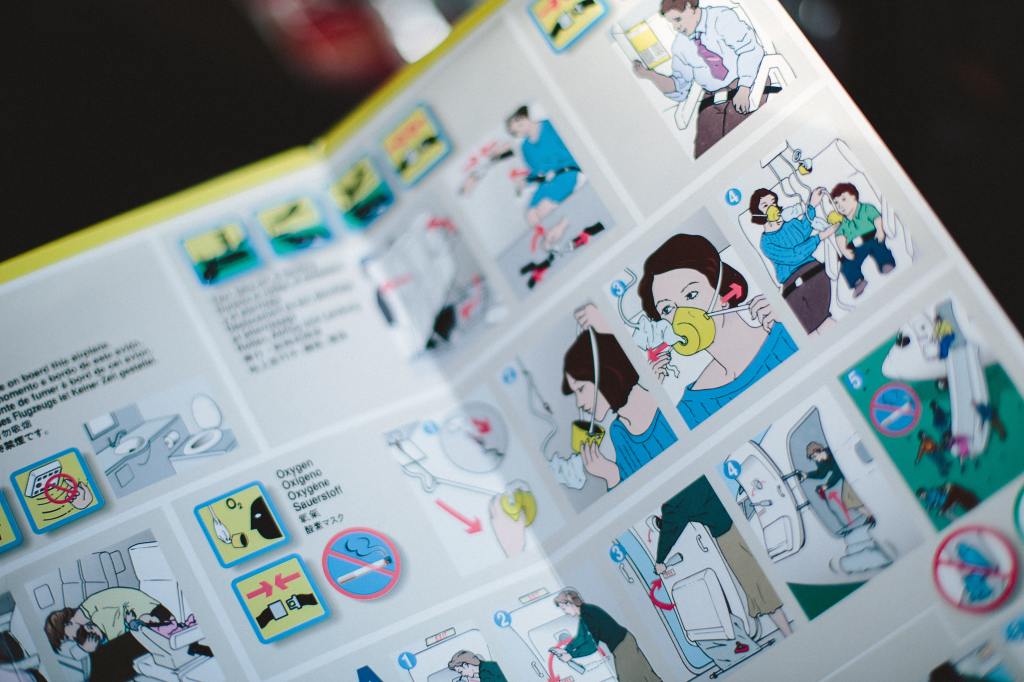
One common example of taking care of yourself before assisting others has been depicted on airline safety cards, perhaps since the advent of commercial aviation. The safety card displays an adult placing and securing her oxygen mask before turning to the child next to her to put on his mask.
That must not be his mother.
I made this conclusion when I first saw this safety card as a 4-year-old child. I noticed how calm the woman was, how helpless the child looked, and how nonchalantly the woman glanced over only after putting on her mask to check the child’s status and whereabouts. She must not love him, I thought as I put the card away, partially disgusted and partially perplexed.
By now, my mother, whom I have always known to be generous and selfless in almost every aspect of her life, started taking out the safety cards to show me the pictures. “No!!!!” I shouted, frantically kicking the card back into the seat before us. Looking back, I’m unsure if that was an act of self-preservation or whether I wanted to protect my mom from the same emotional distress I encountered moments earlier.
In absolutism, the woman is considered selfish because she puts her mask on first. She did not look at the child beside her until her safety was secured. While as a child, I found this to be a selfish act; others would probably label this as a practical act or an act of survival. You first need to survive before you can accomplish anything else. Still, something didn’t sit right with me.
I opened this safety card numerous times throughout the flight, returning to the same question and finding others. Was the woman in the picture selfish for putting her mask on first? Or was she selfish but justified in her actions since it was to protect her own life? Is it okay to do a selfish act first, knowing that afterward, you have the potential to help others?
I’ve thought about the countless religious martyrs– Jesus Christ, Gandhi, Mother Teresa, Joan of Arc, and many others who came before us. They sacrificed everything for their lives in pursuit of selflessness, religion, and the love of their people. For those whose lives ended in a public display, they showed us ultimate sacrifice and selflessness.
Does that mean selfishness and selflessness exist on a spectrum? What level of selflessness should we rise to be considered selfless, and who judges this? Are some acts just inherently selfless or selfish regardless of the surrounding circumstances? Are we meant to be merely self-critics of our acts? The biggest question is that if someone commits a selfless act that never had a single witness, is it still a selfless act, and is the person still considered selfless? If no one other than you knows that you have contributed to a charity anonymously, would others still consider you selfless? Must they witness the original act themselves, or is it enough for them to hear a retelling from you to consider you a selfless being?
In the ever-churning wheels of my brain, this may require more abstract thought than I once believed. This teaches me to slow down and consider each word’s possibilities and meanings. In addition, every person has a different background and a different upbringing. Perhaps an act or mannerism one person was taught was selfish was what another person required to survive.
When you think of someone selfish, consider why they are selfish. Is that person merely that way with you or all the time, across different contexts? What about someone selfless? Are they always selfless or only sometimes? Where is the line between selfish and selfless? Could it also have something to do with outsider knowledge? Hypothetically, your coworker never picks up anyone else’s shifts and always leaves immediately after work.
In contrast, others have time to hang out and grab drinks to better acquaint themselves with one another. However, this one coworker has never done so and has never done anything more than the bare minimum. You might see her as a very selfish, egocentric individual. What if one day you found out that she had three small kids to pick up from daycare and a disabled husband whom she cared for from the moment she got home to when she left for work again? This insider knowledge of your coworker’s life can completely change your perception of her. Would you consider her a selfless and devoted mother and spouse or selfish, but in a good way? Could she be both? Is selfish a word that carries an inherently bad or negative connotation, and is selfless a word that carries an inherently good or positive connotation?
My never-ending search for answers to all these questions ended not too long ago when I found the answer I was perhaps subconsciously seeking.
I was driving in my car, listening to an audiobook, The Code of the Extraordinary Mind, by Vishen Lakhiani. What he said resonated with me so well that I only wish I had come across his book sooner. Lakhiani urges and supports people to live the lifestyle they wish to live. He continues, “certain people will tell you that you’re being unfaithful to your traditions or cultural norms or that you’re being selfish. Here’s what [he] want[s] you to know. Some say, the heart is the most selfish organ in the human body because it keeps all the good blood for itself– the most oxygenated blood, and distributes the rest to every other organ. So in a sense, maybe the heart is selfish. But if the heart didn’t keep the good blood for itself, the heart would die. And if the heart died, it would take every other organ with it– the liver, the kidneys, the brain. The heart, in a way, has to be selfish for its own preservation, so don’t let people tell you that you are selfish and wrong to follow your own heart. [He] urge[s] you. [He] give[s] you permission to break the rules– to think outside the norms of traditional society.”
They say that you must first take care of yourself before taking care of others. Growing up, I watched my generous mother commit numerous selfless acts for others, whether they were down on their luck or underprivileged. As far as I saw and knew, my mother has always helped everyone she could, even in the smallest of ways, whether helping an old woman cross the street or offering to drive a neighbor’s child to school. While I knew my mother was kind, as a child, I also believed all mothers were like this– generous, helpful, caring, loving, and devoted parents. Thus, when I saw the airplane safety card for the first time, I didn’t believe that it could be the boy’s mother. In my heart, I thought that my mother would seek to help me and my sister first before helping herself. But I also knew we could follow those instructions ourselves and put our masks on simultaneously. So, my mind is finally at ease.

 Sip of Ambition